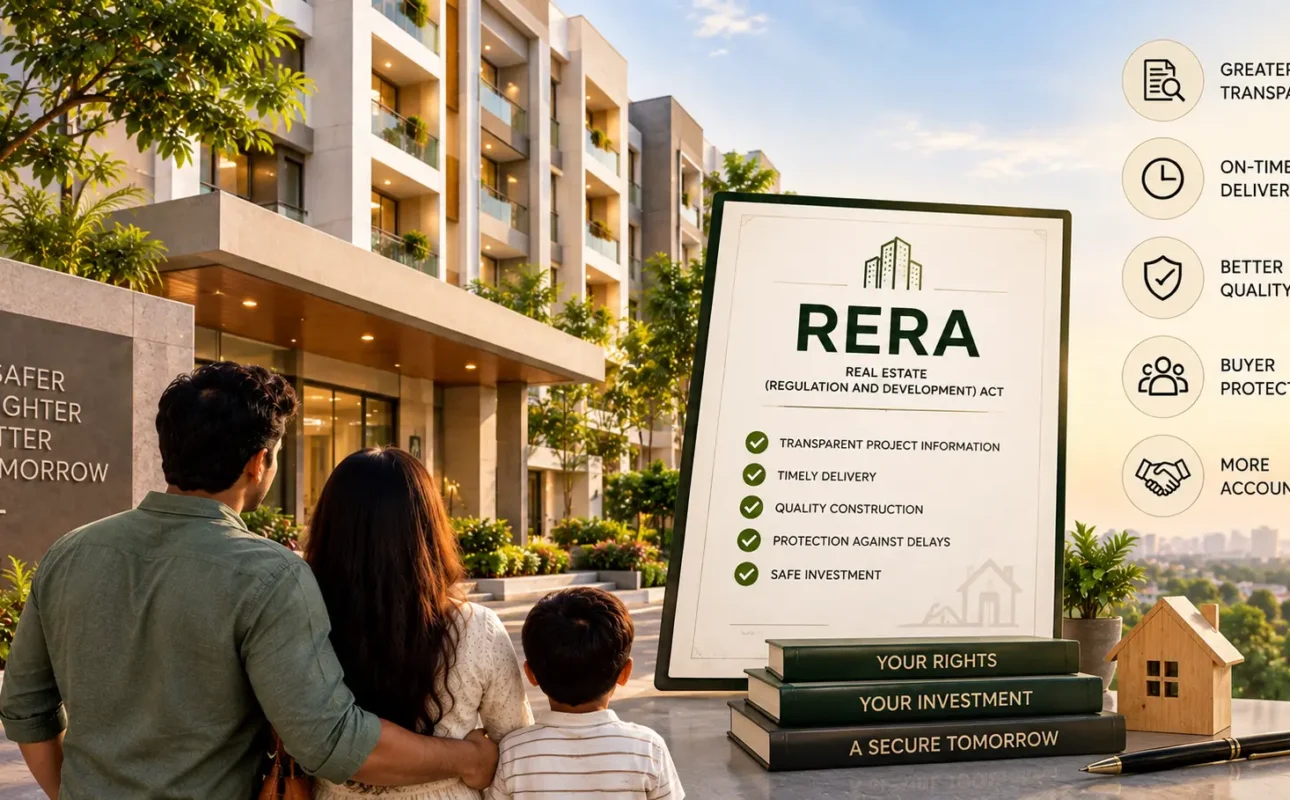
The Real Estate (Regulation and Development) Act, 2016 RERA was created to improve transparency, accountability, and buyer protection. In Chennai, the relevant state authority is the Tamil Nadu Real Estate Regulatory Authority, or TNRERA.
RERA helps buyers check project information, understand carpet area, compare timelines and seek remedies where the Act applies. It does not replace legal or technical checks. Here is what to verify before buying a property in Chennai.
What Is RERA?
RERA stands for the Real Estate (Regulation and Development) Act, 2016. It regulates specified projects, promoters and agents and creates complaint and appeal mechanisms. In Tamil Nadu, TNRERA administers the framework. Buyers can use the official TNRERA website to search registered projects and review records.
Not every property requires registration. Statutory exemptions cover certain smaller projects, projects that received a completion certificate before the Act commenced, and specified renovation or redevelopment without new marketing, sale or allotment. However, project age alone is not a reliable test: an ongoing project without a completion certificate when the relevant provisions commenced could require registration. Verify the exact project instead of relying on a verbal claim.
Why Was RERA Introduced?
Homebuyers historically faced problems such as incomplete disclosure, uncertain delivery dates, misleading promotions, inconsistent descriptions of saleable area, diversion of project collections and difficult dispute resolution. RERA addresses these issues through registration, disclosure and accountability requirements.
How Does RERA Protect Homebuyers?
1. Project registration and information transparency
A promoter cannot advertise, market, book or sell a covered project in a planning area without registration. The filed information includes promoter details, plans, approvals, location, apartment types, carpet areas, title and encumbrance declarations, and the completion period. Buyers can compare this formal record with the sales material they receive.
2. Carpet-area disclosure
RERA defines carpet area as the net usable floor area excluding external walls, service shafts, exclusive balconies or verandahs and exclusive open terraces, while including internal partition walls. Compare like with like; do not compare one property’s carpet area with another’s super built-up area. See Viva Housing’s guide to carpet area, built-up area and super built-up area.
3. Protection of project collections
Promoters must deposit 70% of amounts realised from allottees for a project into a separate account in a scheduled bank for that project’s land and construction costs. Withdrawals are linked to completion and prescribed certifications. “Separate account” is more accurate than “escrow.” The rule limits diversion of collections but does not guarantee timely completion.
4. Remedies for qualifying project delays
If the promoter fails to complete or give possession according to the agreement for sale, Section 18 provides remedies. A withdrawing allottee may seek return of the amount with prescribed interest and applicable compensation; one who remains may be entitled to prescribed interest for the delay. The result depends on the agreement, facts and applicable order.
5. Accountability for advertisements and representations
The Act provides remedies where a person advances money based on an incorrect or false statement in specified advertisements, notices, prospectuses or model properties and suffers loss or damage. Compare sales material with the TNRERA record and agreement, and retain dated copies.
6. Protection during booking
A promoter cannot accept more than 10% of the property’s cost as an advance or application fee without first entering into a written and registered agreement for sale. Still check the proposed agreement, total-cost sheet and project record before making any substantial payment.
7. Defect liability after possession
Specified structural defects and defects in workmanship, quality, services or promoter obligations under the agreement, when reported within five years from handover, must be rectified without further charge within 30 days. If not, the allottee may seek compensation under the Act. This does not automatically cover every maintenance issue, so document the defect and response.
8. Complaint and dispute mechanism
An aggrieved person may complain to the Authority or adjudicating officer, as applicable, for a violation of the Act, rules or regulations. Do not treat 60 days as a guaranteed decision time: the Act provides a 60-day disposal period in relevant contexts and requires reasons when it is exceeded. Follow current TNRERA forms, fees and instructions.Specified structural defects and defects in workmanship, quality, services or promoter obligations under the agreement, when reported within five years from handover, must be rectified without further charge within 30 days. If not, the allottee may seek compensation under the Act. This does not automatically cover every maintenance issue, so document the defect and response.
RERA Requirements at a Glance
| RERA provision | What it means for a buyer |
|---|---|
| Project registration | Covered projects must register before specified marketing and sales activity |
| Project disclosure | Specified plans, approvals, areas and timelines are filed |
| Carpet-area disclosure | A standard definition supports clearer comparisons |
| 70% separate account | Specified collections are restricted to project land and construction costs |
| Completion period | Buyers can compare the declared timeline with their agreement |
| Advertising accountability | Remedies may apply to loss caused by false information |
| 10% advance rule | An agreement for sale is required before collecting more than 10% |
| Defect provision | Specified defects reported within five years must be addressed |
| Complaint framework | Aggrieved persons have regulatory routes where applicable |
How to Check Whether a Property Is RERA Registered in Tamil Nadu
- Visit the Tamil Nadu RERA portal.
- Open the relevant registered-project search for a building or layout, as applicable.
- Search by the available project name, promoter name or registration detail.
- Match the project name, promoter and location to the offered property.
- Review the registration period, status, approvals, plans and updates.
- Compare the record with the brochure, cost sheet, booking form and draft agreement.
Registration may be phase-specific. Confirm that the exact building, phase or layout being sold appears in the record.

What Should You Check on a TNRERA Project Record?
Do not stop at the registration number. Check:
- registration validity and exact project or phase name
- promoter’s legal name and project location
- declared completion or possession information
- apartment or plot details and carpet area
- available approvals, plans and project updates
- displayed extensions, complaints or orders
Save a dated copy and recheck the portal before signing the agreement or making a major payment.
RERA Registration vs CMDA or DTCP Approval and Legal Verification
RERA registration is not the same as planning approval, and it does not replace title due diligence.
| Check | Main purpose |
|---|---|
| TNRERA registration | Project regulation, disclosure and buyer protections |
| CMDA or DTCP permission | Planning and development permission for the jurisdiction |
| Title review | Ownership, claims, charges and transfer rights |
| Agreement review | Terms binding the buyer and promoter |
For Chennai Metropolitan Area properties, consult available CMDA planning-permission records. For DTCP areas, use the official Tamil Nadu DTCP website. The relevant authority depends on the property’s jurisdiction; obtain legal confirmation rather than guessing from its address.
Does RERA Registration Mean a Property Is Completely Risk-Free?
No. Registration is not a certificate that every legal, technical, financial or location risk has been removed, and it should not be called “RERA approval.” Verify title, encumbrances, planning and building permissions, agreement terms, total costs, construction status and the specific project record. Viva Housing’s property buying guide and legal guide can help organise these checks.
RERA Checklist Before Buying a Flat in Chennai
- Find the exact project or phase on the official TNRERA portal.
- Match the promoter, project name, location and registration number.
- Review the declared completion information and current updates.
- Confirm carpet area and compare like-for-like measurements.
- Compare advertised plans and amenities with registered information.
- Obtain the total-cost sheet and payment schedule.
- Read the agreement before a substantial payment.
- Verify applicable planning and building permissions.
- Arrange independent title and encumbrance checks.
- Keep advertisements, documents, receipts and correspondence.
How RERA Helps You Make a Better-Informed Decision
RERA helps Chennai homebuyers compare registered information, delivery details and written promises. Check the exact project on TNRERA, read the agreement and retain your records.
Use RERA alongside planning-permission checks, title review, financial assessment and physical inspection. Seek qualified advice before committing funds. You can explore Viva Housing’s current projects or contact the team for project-specific documents.
Frequently Asked Questions
1. What is RERA, and why is it important for homebuyers?
RERA is the Real Estate (Regulation and Development) Act, 2016. It sets registration, disclosure and accountability requirements for covered projects and establishes buyer rights and complaint mechanisms. It does not replace independent legal and technical checks.
2. How can I check RERA registration in Tamil Nadu?
Use the official TNRERA project search. Match the promoter, exact project or phase, location and registration details with the property offered. Do not rely only on a number printed in a brochure.
3. Is RERA registration mandatory for every property project?
No. Statutory thresholds and exemptions apply, including to certain smaller developments, previously completed projects and specified renovation or redevelopment without new sale or allotment. Verify the exact project on TNRERA.
4. Is RERA registration the same as CMDA approval?
No. TNRERA concerns project regulation and disclosure; CMDA or DTCP permission concerns planning and development. Buyers may need to verify both, along with title, encumbrances and their agreement.
5. Can a promoter collect a booking amount before an agreement for sale?
A promoter cannot collect more than 10% of the property’s cost as an advance or application fee without a written and registered agreement for sale. Check the booking terms, cost sheet and refund conditions before paying.
6. What can a buyer do if a RERA-registered project is delayed?
If possession is not provided according to the agreement, remedies may include withdrawal with return of the amount and prescribed interest, or prescribed interest for delay when the buyer remains. Outcomes depend on the facts and applicable proceedings.
7. What is the five-year defect-liability provision?
Specified structural, workmanship, quality, service or agreement-related defects reported within five years from handover must be rectified without charge within 30 days. If not, the allottee may seek compensation under the Act.
8. Can a buyer file a complaint with TNRERA?
An aggrieved person may complain to the Authority or adjudicating officer, as applicable, for a violation of the Act, rules or regulations. Follow the current forms, fees and instructions on TNRERA.
Legal note: This article provides general educational information and is not legal advice. Regulations, procedures and project records can change. Check the current official sources and obtain advice from an appropriately qualified professional for a specific transaction or dispute.



1 Comment
This is such an empowering and crucial read for every prospective property buyer! RERA has fundamentally reshaped the Indian real estate landscape, turning what used to be an ambiguous process into a transparent, accountable journey. The mandatory escrow mechanism and standardized carpet area definitions alone have removed immense uncertainty and restored homebuyer confidence.
For reputable developers who have always prioritized ethical practices and on-time delivery, RERA was a welcome reform—it rightly elevates builders who focus on customer trust. We have championed transparency across all our developments in Mumbai for decades, and we always urge buyers to check RERA registrations before signing on the dotted line. Thanks for laying out these safeguards so clearly! For anyone in your community looking for fully compliant, premium residential spaces in Mumbai, feel free to visit us at Veena Developers: https://www.veenadevelopers.com/