
The Chennai real estate market in 2026 is being shaped by end-user demand, suburban job growth, major transport projects and buyers seeking better-planned homes within a workable budget. Market activity is not uniform across the city: established neighbourhoods, IT-linked corridors, airport-side locations and outer suburbs each have different pricing, infrastructure and risk profiles.
Industry research points to stronger residential demand during the first half of 2026, along with rising capital values and moderate rental growth. For a homebuyer, however, a citywide trend is only the starting point. The better decision comes from matching the exact project and micro-location to budget, commute, legal checks and long-term household needs.
Chennai Real Estate Market 2026: Quick Overview
| Metric | Latest verified direction |
|---|---|
| Residential demand | Q2 2026 sales reached an eleven-quarter high, while H1 demand grew 26% year on year |
| New launches | Q2 launches rose 7% quarter on quarter, while H1 2026 launches were 13% lower year on year after a strong 2025 |
| Capital values | The cited Q2 review recorded a 13.2% year-on-year increase through H1 2026 |
| Housing rents | The cited Q2 review recorded a moderate 5.6% year-on-year rise |
| Strong-demand areas | The Southern submarket, including Pallavaram and Sholinganallur, accounted for most sales, followed by the Western submarket |
| Launch concentration | Southern and Western suburbs together represented 78% of new units in the cited Q2 review |
| Key influences | Employment access, Metro Phase 2, suburban commercial growth, roads and practical social infrastructure |
According to JLL’s Q2 2026 Chennai residential report, published on 14 August 2026, the table covers sales, launches, capital values, rents and submarkets. A separate H1 dataset in the Sources section reported 9,198 sales, 3% annual sales growth, a 5% price rise and a ₹7,555-per-sq-ft average. Because research methodologies differ, the datasets should not be combined.
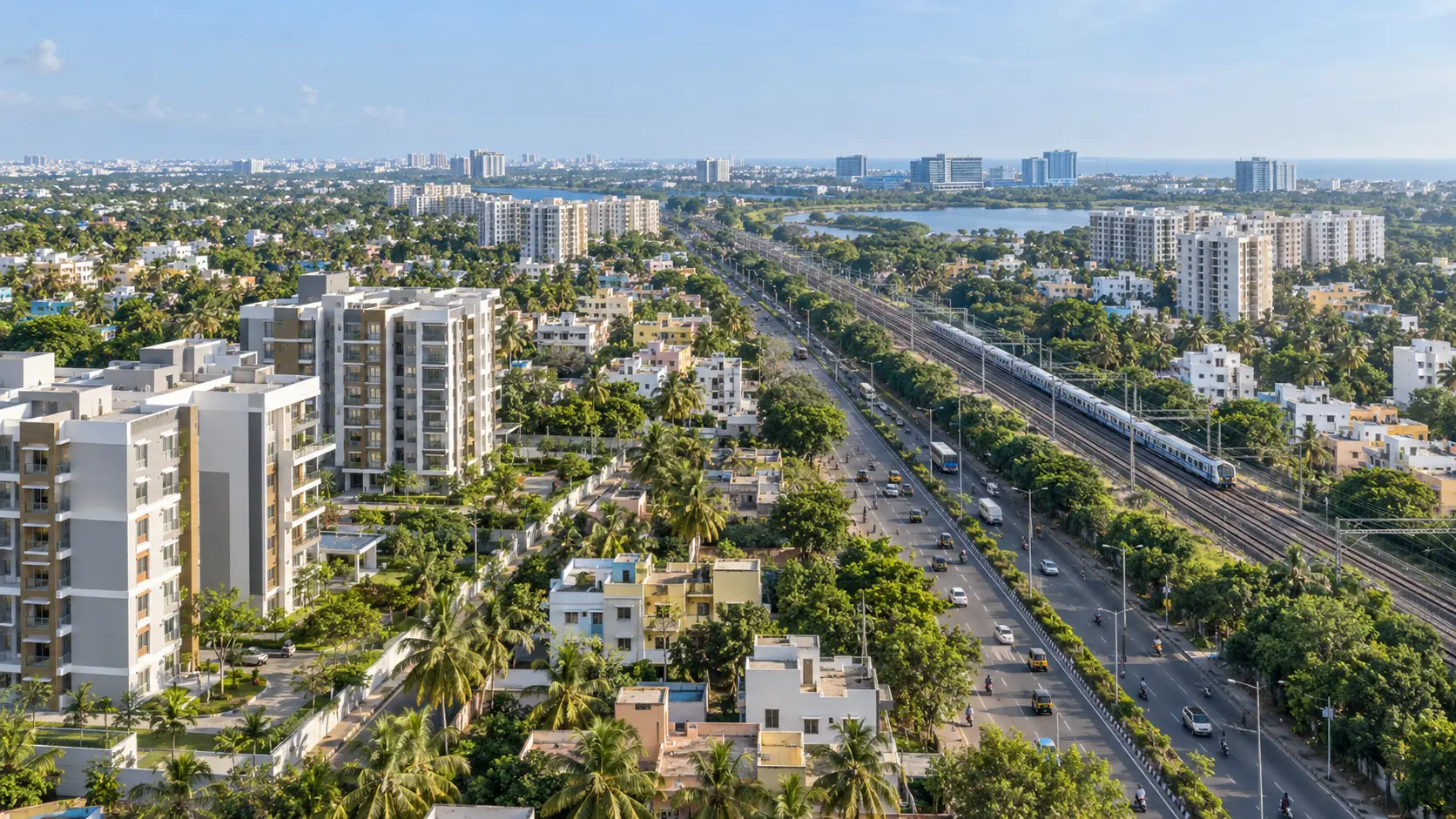
What Is Driving Chennai's Residential Market in 2026?
End-user housing demand
Chennai remains strongly influenced by owner-occupiers. These buyers compare affordability, commute, schools, healthcare, usable space, water, parking and project reliability—not only short-term market sentiment.
IT and employment growth
OMR and Siruseri connect housing demand with technology employment. Airport-side, manufacturing, and western corridors spread demand beyond a single business district.
Infrastructure expansion
Roads, suburban rail, the operational Metro and Phase 2 construction influence travel choices. CMRL lists Chennai Metro Phase 2 as under progress, so future benefits must not be presented as operational.
Suburban growth
Southern and western suburbs offer growing supply, but buyers must examine last-mile roads, drainage, water, public transport and surrounding development.
Demand for practical space
Families increasingly value space for work, study and storage. Room dimensions, ventilation, usable area and maintenance matter more than the BHK label alone.
Chennai Property Price Trends in 2026
Chennai cannot be represented accurately by one price-per-square-foot figure. An overall average combines premium central locations, established suburbs, new high-rise projects, older resale homes and developing outer corridors. Even within one locality, prices vary by street, project age, floor, view, construction status, parking, amenities, approvals and developer.
The cited 2026 market studies both indicate citywide price growth. That does not mean every project or locality rose at the same rate, and it does not guarantee future appreciation.
Before using a portal average, request the current itemised cost sheet for the exact unit and compare it with recent registered transactions where available, competing projects and resale listings of similar age and specification. Guideline value, portal asking price, developer quotation and final registered value are different measures.
How to Compare Chennai Locations Without Misusing Price Averages
| Corridor | Market character | Main demand driver | Buyer checks |
|---|---|---|---|
| Pallavaram and GST Road | Established airport-side residential corridor | GST Road, suburban rail, airport-side access and Radial Road | Aircraft or road noise, last-mile route, water and drainage |
| Pammal and South-West Chennai | Predominantly residential micro-markets | Access towards Pallavaram, GST Road and airport-side areas | Inner-road width, commute route and exact project access |
| Tambaram and southern GST corridor | Established suburban centre | Rail, road, education, healthcare and retail | Micro-location congestion, travel time and project age |
| Pallikaranai–Perumbakkam | Family-oriented southern belt | Access towards OMR and surrounding social infrastructure | Street-level drainage history, water and peak-hour traffic |
| OMR–Sholinganallur | Employment-linked apartment corridor | Technology offices and expanding transport infrastructure | Congestion, water source, maintenance and construction activity |
| Navalur–Siruseri–Kelambakkam | Developing southern IT corridor | Siruseri employment and newer residential supply | Distance to daily needs, commute beyond OMR and resale depth |
| Porur and West Chennai | Established and developing western market | Employment, healthcare, road access and Metro Phase 2 influence | Current construction disruption, road route and micro-market price |
Current locality prices are intentionally not reproduced here because portal bands change and are not transaction quotations. Use them only as a screening tool, then verify the exact unit and date.
Emerging Real Estate Corridors in Chennai for 2026
Pallavaram and the GST Road–Radial Road corridor
Pallavaram combines an established residential base with GST Road, suburban rail, airport-side access and the Radial Road towards eastern Chennai. It forms part of the southern submarket that led sales in the cited Q2 review. Pallavaram does not have an operational Metro station; Airport Metro requires a last-mile connection. Before comparing Pallavaram residential options, check the exact route, noise, drainage and project documents.
Pammal and South-West Chennai
Pammal is a residential alternative within the wider Pallavaram–airport-side belt. Access to GST Road, rail and the airport varies by street. Test peak-hour travel, road width, water and drainage before reviewing homes in Pammal.
Tambaram and the southern GST corridor
Tambaram is an established South Chennai transport and service centre with rail, roads, education, healthcare and retail. Buyers should still compare the exact neighbourhood because traffic, access, building age and development patterns vary.
Pallikaranai–Perumbakkam belt
This belt attracts families seeking access towards OMR. Verify drainage and flood history for the exact street, water arrangements, road elevation and peak-hour travel rather than relying on the locality’s general reputation.
OMR–Sholinganallur corridor
OMR’s technology base supports apartment and rental demand, while Sholinganallur forms part of the sales-leading southern submarket in the cited Q2 review. Buyers should compare water sources, congestion, maintenance, construction activity and the status of nearby Phase 2 work.
Navalur–Siruseri–Kelambakkam corridor
Further south, new supply and Siruseri employment attract first-time and IT-linked buyers. Longer central-city travel and uneven last-mile services are possible. Verify schools, healthcare, transport and retail without treating proposed infrastructure as completed.
Porur and West Chennai
Porur and nearby western locations combine housing with employment, healthcare and established routes. The cited Q2 review placed the Western submarket after the South in demand. Buyers should plan around today’s roads and Phase 2 construction conditions.
Where Is Buyer Demand Concentrated in Chennai?
Demand is strongest where monthly outflow, employment access, usable layouts and everyday infrastructure work together. Compare complete cost—including statutory charges, finance, interiors, parking, deposits and maintenance—not only the base rate.
Project status also matters. Some buyers value the inspection and earlier occupancy of a ready home; others accept construction-stage risk for a different payment schedule or product choice. Review Viva Housing’s guide to under-construction versus ready-to-move property for that decision.
2 BHK vs 3 BHK: What Are Chennai Buyers Looking For?
| Factor | 2 BHK | 3 BHK |
|---|---|---|
| Typical buyer | First-time buyers, couples and smaller households | Larger, growing or multigenerational families and upgraders |
| Initial cost | Generally lower within the same project | Generally higher within the same project |
| Space | Practical when rooms and storage are efficient | More flexibility for work, guests or future household needs |
| Rental audience | Often broad and budget-sensitive | More focused on families needing additional space |
| Long-term suitability | Depends on household growth | May reduce the need to upgrade, if affordable to maintain |
Neither configuration is universally better. Compare carpet area, room dimensions, ventilation, storage, parking, maintenance and total loan outflow—not just the BHK label.
Infrastructure Influencing Chennai Real Estate
Chennai Metro Phase 2
CMRL identifies Phase 2 as under progress. It can influence buyer expectations across southern and western corridors, but station access, construction timelines and opening dates must be checked on official CMRL sources. A proposed or under-construction connection should never be marketed as operating.
Pallavaram–Thoraipakkam Radial Road
The Radial Road creates a road connection between the airport-side/GST corridor and the OMR side. Its practical value depends on the exact start point, destination, junctions and peak-hour traffic.
OMR and employment-led demand
Technology offices around OMR and Siruseri continue to shape both owner-occupier and rental demand. Proximity should be measured as a door-to-door commute, including the last mile.
GST Road and suburban rail
GST Road and the suburban railway network remain important for southern locations such as Pallavaram, Chromepet and Tambaram. Projects within the same locality can have very different access to these transport options.
Established Areas vs Emerging Corridors
| Factor | Established areas | Emerging corridors |
|---|---|---|
| Entry cost | Often higher | May be comparatively lower |
| Social infrastructure | Usually more mature | Can be uneven or developing |
| New-project choice | May be limited or redevelopment-led | Often broader |
| Rental market | Usually easier to assess | Highly location-dependent |
| Growth drivers | Existing demand and limited supply | Employment and infrastructure expansion |
| Main buyer check | Whether the convenience justifies the price | Whether current infrastructure is sufficient without relying on promises |
Which Chennai Location Fits Different Buyer Goals?
- For IT-corridor access: OMR, Sholinganallur and locations further south may suit buyers whose routine is centred on technology employment. Test peak-hour travel and water arrangements.
- For airport and GST Road access: Pallavaram, Pammal and nearby southern locations may be relevant. Compare the exact route to GST Road, rail or Airport Metro rather than using broad distance claims.
- For established social infrastructure: Tambaram and established city or suburban markets may offer mature schools, healthcare and retail, usually with different price and supply conditions.
- For emerging suburban choice: Southern and western growth corridors may offer newer supply. Buyers should accept only infrastructure that exists today in their base decision.
Use Viva Housing’s Chennai locality guide to structure comparisons around commute, services and property suitability.
What Should Homebuyers Check Before Buying Property in Chennai?

- Verify the project on TNRERA where registration is applicable.
- Arrange independent legal review of title, encumbrance, approvals, plans and the agreement.
- Confirm construction or completion status and the declared possession terms.
- Request an itemised total-cost sheet, not only the advertised base price.
- Test the commute from the exact entrance during normal travel hours.
- Check water source, drainage and flood history for the precise micro-location.
- Inspect parking, approach roads, usable space, ventilation and common areas.
- Review maintenance charges, association arrangements and future recurring costs.
- Confirm loan eligibility and comfortable repayment directly with the lender.
For a broader process, read Viva Housing’s property buying guide and property legal guide.
Chennai Residential Market Outlook for 2026 and Beyond
The cited Q2 market outlook expects near-term residential momentum to continue beyond Chennai’s core areas, supported by suburban office expansion. It also anticipates medium-term movement in rents and capital values, with Metro Phase 2 expected to improve connections between suburban locations and major office and retail hubs as sections become operational.
That is a market outlook, not a guarantee for every locality or project. New supply can alter competition, approval delays can affect launches, and infrastructure timelines can change. Buyers should therefore base affordability on today’s income and today’s usable connectivity rather than a future appreciation assumption.
The most durable trend is Chennai’s micro-market character. Southern and western corridors may continue to attract launches and demand, while established areas retain the advantage of mature services. Project quality, legal clarity, complete cost and micro-location will remain more important than a broad claim that one side of the city is “best.”
Final Takeaway
Chennai is not one homogeneous property market. The right location depends on six connected factors: budget, commute, purchase purpose, existing infrastructure, project quality and expected holding period.
Use market reports to understand direction, then verify the exact home. Visit at different times, compare complete costs, examine current documents and test the everyday route before deciding. Buyers ready to compare specific options can explore Viva Housing projects or contact Viva Housing to request current project information and arrange a site visit.
Frequently Asked Questions
1. How is the Chennai real estate market performing in 2026?
The cited Q2 2026 market review recorded an eleven-quarter sales high, 26% year-on-year demand growth in H1, higher capital values and moderate rental growth. Individual localities and projects can perform differently.
2. What is the average property price in Chennai in 2026?
A separately cited H1 2026 dataset gave a citywide average of ₹7,555 per sq ft. It should not be used as a quotation: exact prices vary substantially by locality, project, unit and date.
3. Which areas of Chennai are seeing residential demand?
The cited Q2 review found that the Southern submarket, including Pallavaram and Sholinganallur, accounted for most sales, followed by the Western submarket. Demand remains specific to each project and micro-location.
4. Is Pallavaram a growing residential market?
Pallavaram forms part of the southern submarket highlighted in the cited Q2 review. Its established residential base, GST Road, suburban rail, airport-side position and Radial Road make it relevant, but buyers must assess the exact project’s access, documents, water, drainage and noise.
5. Is a 2 BHK or 3 BHK better in Chennai?
A 2 BHK may suit a smaller household or lower budget, while a 3 BHK may offer greater long-term flexibility. Compare usable area, room dimensions, maintenance and total loan outflow before choosing.
6. What should I check before buying a flat in Chennai?
Check applicable RERA registration, title and encumbrance records, approvals, agreement terms, total cost, construction status, water, drainage, parking, maintenance, exact commute and loan affordability. Obtain independent professional advice for the specific transaction.
Disclaimer
This article provides general educational information, not legal, tax, financial or investment advice. Market figures use cited reports available on 18 September 2026 and may follow different methodologies. Prices, project status, approvals, infrastructure timelines and availability can change. Verify the exact property with current official records, the developer and qualified professionals before making a decision.

1 Comment
This is a fantastic update on Chennai’s evolving property landscape! It is fascinating to see how the combination of major infrastructure upgrades and expanding corporate corridors is reshaping buyer priorities across the city. The growing preference for well-connected gated communities that prioritize open space and everyday convenience is clearly defining this current phase of growth.
We are witnessing remarkably similar shifts across Mumbai as well—homebuyers in major metros are increasingly looking for balanced, lifestyle-centric homes that offer long-term value and community living. Thanks for sharing such clear market insights! If any of your readers are also exploring premium residential opportunities in Mumbai, we’d be glad to welcome them at Veena Developers: https://www.veenadevelopers.com