Viva Housing | Builders in South Chennai

How RERA protects homebuyers in Chennai

How RERA Protects You as a Homebuyer

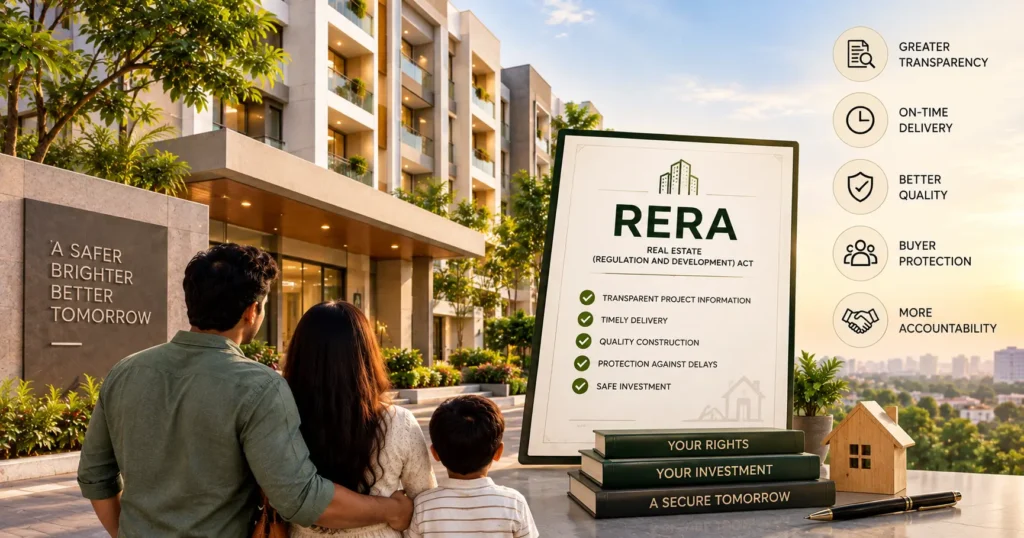
The Real Estate (Regulation and Development) Act, 2016 RERA was created to improve transparency, accountability, and buyer protection. In Chennai, the relevant state authority is the Tamil Nadu Real Estate Regulatory Authority, or TNRERA. RERA helps buyers check project information, understand carpet area, compare timelines and seek remedies where the Act applies. It does not replace legal or technical checks. Here is what to verify before buying a property in Chennai. What Is RERA? RERA stands for the Real Estate (Regulation and Development) Act, 2016. It regulates specified projects, promoters and agents and creates complaint and appeal mechanisms. In Tamil Nadu, TNRERA administers the framework. Buyers can use the official TNRERA website to search registered projects and review records. Not every property requires registration. Statutory exemptions cover certain smaller projects, projects that received a completion certificate before the Act commenced, and specified renovation or redevelopment without new marketing, sale or allotment. However, project age alone is not a reliable test: an ongoing project without a completion certificate when the relevant provisions commenced could require registration. Verify the exact project instead of relying on a verbal claim. Why Was RERA Introduced? Homebuyers historically faced problems such as incomplete disclosure, uncertain delivery dates, misleading promotions, inconsistent descriptions of saleable area, diversion of project collections and difficult dispute resolution. RERA addresses these issues through registration, disclosure and accountability requirements. How Does RERA Protect Homebuyers? 1. Project registration and information transparency A promoter cannot advertise, market, book or sell a covered project in a planning area without registration. The filed information includes promoter details, plans, approvals, location, apartment types, carpet areas, title and encumbrance declarations, and the completion period. Buyers can compare this formal record with the sales material they receive. 2. Carpet-area disclosure RERA defines carpet area as the net usable floor area excluding external walls, service shafts, exclusive balconies or verandahs and exclusive open terraces, while including internal partition walls. Compare like with like; do not compare one property’s carpet area with another’s super built-up area. See Viva Housing’s guide to carpet area, built-up area and super built-up area. 3. Protection of project collections Promoters must deposit 70% of amounts realised from allottees for a project into a separate account in a scheduled bank for that project’s land and construction costs. Withdrawals are linked to completion and prescribed certifications. “Separate account” is more accurate than “escrow.” The rule limits diversion of collections but does not guarantee timely completion. 4. Remedies for qualifying project delays If the promoter fails to complete or give possession according to the agreement for sale, Section 18 provides remedies. A withdrawing allottee may seek return of the amount with prescribed interest and applicable compensation; one who remains may be entitled to prescribed interest for the delay. The result depends on the agreement, facts and applicable order. 5. Accountability for advertisements and representations The Act provides remedies where a person advances money based on an incorrect or false statement in specified advertisements, notices, prospectuses or model properties and suffers loss or damage. Compare sales material with the TNRERA record and agreement, and retain dated copies. 6. Protection during booking A promoter cannot accept more than 10% of the property’s cost as an advance or application fee without first entering into a written and registered agreement for sale. Still check the proposed agreement, total-cost sheet and project record before making any substantial payment. 7. Defect liability after possession Specified structural defects and defects in workmanship, quality, services or promoter obligations under the agreement, when reported within five years from handover, must be rectified without further charge within 30 days. If not, the allottee may seek compensation under the Act. This does not automatically cover every maintenance issue, so document the defect and response. 8. Complaint and dispute mechanism An aggrieved person may complain to the Authority or adjudicating officer, as applicable, for a violation of the Act, rules or regulations. Do not treat 60 days as a guaranteed decision time: the Act provides a 60-day disposal period in relevant contexts and requires reasons when it is exceeded. Follow current TNRERA forms, fees and instructions.Specified structural defects and defects in workmanship, quality, services or promoter obligations under the agreement, when reported within five years from handover, must be rectified without further charge within 30 days. If not, the allottee may seek compensation under the Act. This does not automatically cover every maintenance issue, so document the defect and response. RERA Requirements at a Glance RERA provision What it means for a buyer Project registration Covered projects must register before specified marketing and sales activity Project disclosure Specified plans, approvals, areas and timelines are filed Carpet-area disclosure A standard definition supports clearer comparisons 70% separate account Specified collections are restricted to project land and construction costs Completion period Buyers can compare the declared timeline with their agreement Advertising accountability Remedies may apply to loss caused by false information 10% advance rule An agreement for sale is required before collecting more than 10% Defect provision Specified defects reported within five years must be addressed Complaint framework Aggrieved persons have regulatory routes where applicable How to Check Whether a Property Is RERA Registered in Tamil Nadu Visit the Tamil Nadu RERA portal. Open the relevant registered-project search for a building or layout, as applicable. Search by the available project name, promoter name or registration detail. Match the project name, promoter and location to the offered property. Review the registration period, status, approvals, plans and updates. Compare the record with the brochure, cost sheet, booking form and draft agreement. Registration may be phase-specific. Confirm that the exact building, phase or layout being sold appears in the record. What Should You Check on a TNRERA Project Record? Do not stop at the registration number. Check: registration validity and exact project or phase name promoter’s legal name and project location declared completion or possession information apartment or plot details and carpet area available approvals, plans and project updates displayed extensions, complaints or orders Save a dated

What is UDS in property and undivided share of land in apartments

What Is UDS (Undivided Share) and Why It Matters When Buying a Flat

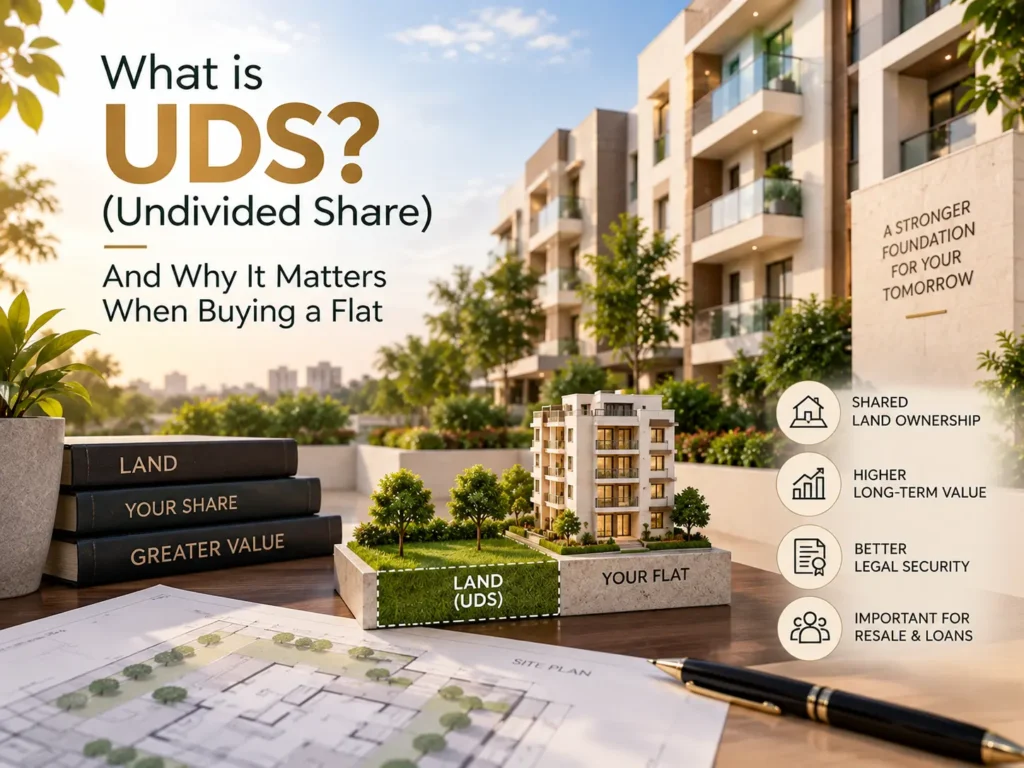
If you’re considering purchasing a flat in Chennai or indeed anywhere in India, you will certainly come across the term Undivided Share of land. Although the term sounds legalistic and esoteric, it will have an immediate, profound implications for your property value, legality, and future resale. Yet, so many homebuyers miss or misinterpret this. Let’s clarify this in a succinct and matter-of-factness way, based on the actual reality of the Chennai property market. What Is UDS? When you buy a flat in a multi-storey apartment, you are not only buying the built-up area (flat) you are also buying a share of the land that the entire building is constructed on. This share of the land that is allotted to you is referred to as the Undivided Share (UDS). For example, if a developer had 5,000 sq ft of land and built ten apartments on the land, the each apartment could have a UDS of 500 sq ft each. (This is a vastly simplified version of this, the actual calculation varies and in reality, there would be many other factors.) UDS is intangible in the sense that while you can measure, partition and modify the flat, UDS is not something you can tangibly measure on the ground. However, from a legal standpoint it is in fact your share of land. It will be referred to in your sale deed. Why Is UDS Crucial? 1. Legal Ownership of Land UDS is your only legal proof of ownership of land. Without UDS, you own only the structure, which depreciates over time, but not the appreciating asset: land. This is especially important in Chennai where land prices in places like Pallavaram, Madipakkam, Tambaram have been rising steadily over the years. Historically and statistically, the value of your investment will depend more on the land than the building. 2. Future Redevelopment Rights In cities like Chennai it is not uncommon for older buildings to be demolished and redeveloped. For individuals that have a proper UDS in a substantial amount, you are entitled to a proportionate say and share of any redevelopment. A low UDS means your bargaining power and compensation might also be lower. Redevelopment is also tied to Floor Area Ratio (FAR) regulations, which determine how much built-up area is allowed on a given piece of land—making UDS a critical factor. 3. Resale and Market Value Buyers today are better informed. A flat with a higher UDS usually commands a better resale value. It reflects the buyer’s share in the land, which continues to appreciate even if the building ages. Localities like Sembakkam and Pozhichalur are seeing increased interest for this reason, especially among second-time buyers who understand the nuances of land share. 4. Loan Eligibility and Legal Safety Banks in Chennai often evaluate the UDS before approving a home loan. A clear, legally registered UDS is seen as a sign of a clean property title. If UDS is not mentioned or seems too low, it could be a red flag for banks—and for you. Additionally, UDS clarity also protects you against potential litigation in the future. Disputes over land ownership or proportionate share often arise in apartments without properly recorded UDS. Common Pitfalls to Avoid UDS and Chennai’s Changing Real Estate Landscape As space becomes tighter in prime zones and vertical living continues to dominate, UDS becomes even more relevant. In suburbs like Pammal and Sembakkam, where gated communities are emerging rapidly, buyers must be aware of their land share. Smart investors are now actively looking at UDS as a core metric—not an afterthought. With increasing land scarcity and more redevelopment activity driven by improved infrastructure and transit-oriented development, UDS can significantly influence your long-term returns. Why Choose Viva Housing At Viva Housing, we make the invisible tangible. Every apartment we build comes with transparent legal documentation, including clearly defined UDS allocations. We work only on CMDA-approved layouts, ensure RERA compliance, and involve leading legal experts to safeguard your investment. Whether you’re looking at a 2BHK in Pozhichalur or a premium unit in Pallavaram, we ensure your rights to the land are as secure as your home above it. Looking for a new apartment for sale near you? Your journey toward a smart investment in Chennai begins with a decision. Make it count with Viva Housing, the best house builders in Chennai. Explore our upcoming projects today and invest not just in square footage but in future-proof ownership.

Buying a house in Chennai as a smart real estate investment

Why Buying a House in Chennai Is a Smart Investment

Chennai’s property market has always grown at a pace of its own. It’s been growing consistently and quietly through the years. Did you know? – The average price of residential properties in Chennai is ₹7146 per sq ft, which is lower than the average prices in cities such as Mumbai and Bangalore? This makes Chennai one among the top choices for those considering investments for the long run. Buying a house in Chennai is not just about property. Its about entering a market that has firm foundations, good location advantages and an evolving infrastructure. Economic Backbone and Employment OpportunitiesChennai’s diverse economy is one of the core reasons behind its real estate market boom today. Development of IT corridors in OMR and Shollinganallur, active automobile manufacturing centers in Sriperambudur and Oragadam, are part of the reasons why the workforce is lured from all over India and beyond. In this way, the demand for houses for sale in South Chennai has continued to rise with its sustained economic surge. For instance, Chennai’s southern suburbs like Pallavaram, Pozhichalur, and Pammal are close to the IT corridor and Chennai International Airport. And they are gaining the attention of renters today. Though these localities offer relatively affordable housing options compared to the city’s center now, a steady rise in rental demand is predicted. Infrastructure and Connectivity Chennai’s infrastructure expansion has been both strategic and future-ready. The Chennai Metro Rail Phase II is poised to transform how people travel on a daily basis. These developments are bringing the formerly peripheral areas into the urban fold and localities like Madipakkam, Tambaram, and Kolapakkam are now seamlessly connected to city’s center. This connectivity is increasing the real estate value in these suburban areas. Furthermore, with the metro rail expansion, improved arterial roads, and reputed educational institutions and hospitals growing in tandem, the real estate prospects in these neighborhoods look promising. Moreover, with the proposed expansion of the airport and development of logistics parks around Pallavaram and Pozhichalur, these areas are increasingly being seen as long-term investment zones. Looking ahead, these areas are well-positioned not just as convenient places to live but as smart investment choices in Chennai’s evolving real estate landscape. Real Estate Trends and Market Stability Unlike speculative markets, Chennai’s property market is characterised by its resilience. There are no sudden price booms and busts. This means that capital appreciation may be slower. But it is always more stable and predictable. For example, according to recent real estate market trends, rental values in Chennai’s southern suburbs have seen a year-on-year rise of 5%-8%. This indicates a healthy ROI for investors. This steady market performance has changed the preferences of homebuyers and they prioritise long-term value over short-term gains today. Because of this, there is a growing demand for a lifestyle that offers strong infrastructure, built-in facilities, and communities, rather than just a roof over their heads. Hence, gated communities and smart townships are becoming the norm today. Builders like Viva Housing are focusing on delivering value through well-planned projects that integrate essential amenities, green spaces, and safety features. This trend appeals strongly to families, NRIs, and retirees alike, and to people who look for security, comfort, and return on investment. Legal and Regulatory Clarity Tamil Nadu’s RERA (Real Estate Regulatory Authority) has brought much-needed transparency into the Chennai real estate system. Buyers now have recourse in case of project delays, false advertising, or poor construction quality. Developers face stricter requirements because of RERA, allowing only ethical players to thrive. Viva Housing, for instance, follows RERA norms across their housing projects, ensuring that homebuyers have access to all documentation and regulatory approvals upfront. Every land record is digitised today. And so, developments in suburbs like Sembakkam and Madambakkam have seen better land documentation and faster approvals in recent years. This reduces the legal risk significantly when compared to many other Indian cities.  Lifestyle and Social Infrastructure Modern homebuyers don’t just look at square footage—they assess how the locality fits into their lifestyle. The rise of educational institutions, multi-specialty hospitals, and malls across areas like Tambaram and Pallavaram makes them attractive not only for families but also for rental income. Accessibility to reputed educational institutions like the Madras Institute of Technology and Velammal and hospitals such as the Hindu Mission in these regions offers residents a balanced, well-supported lifestyle. Public parks, cultural centres, and retail spaces are increasingly integrated into new housing developments, reflecting the demand for holistic living. Localities like Pozhichalur are quietly evolving from sleepy towns into residential hubs with real, tangible lifestyle upgrades. Why Choose Viva Housing A smart investment isn’t just about picking the right city it’s about choosing the right developer. Viva Housing combines local expertise with future-forward design thinking. Our projects are located in emerging micro-markets like Pallavaram, Pozhichalur, and Pammal areas with high potential for appreciation and a strong livability quotient. From legal documentation and UDS clarity to timely delivery and customer-first support, we walk with you at every step. Our RERA-compliant practices, transparent pricing, and thoughtful planning ensure that your investment doesn’t just grow—it supports the life you envision. Looking for good apartments for sale near you? Or individual villas for sale in Chennai? Your journey toward a smart investment in Chennai begins with a decision. Make it count with Viva Housing, the best house builders in Chennai. Explore Viva Housing’s new developmentsDiscover why Chennai South is becoming a top choice for families, professionals, and investors looking for quality living at the right price.

Pammal real estate investment and connectivity in Chennai

PAMMAL: Chennai’s Wise Haven for Astute Investment

PAMMAL: Chennai’s Wise Haven for Astute Investment In the heart of Chennai’s vibrant real estate landscape, the spotlight is now shining brightly on PAMMAL, an emerging area that promises not just a home but a lifestyle. Boasting a blend of urban development and serene surroundings, PAMMAL is quickly becoming the go-to destination for savvy real estate investors. Unveiling the Allure of PAMMAL Nestled amidst the bustling cityscape, PAMMAL stands out as a beacon of growth and opportunity. With a surge in demand for villas and apartments, this developing area is proving to be a real estate hotspot, rivaling established neighborhoods like Pallavaram, Chrompet, Sanatorium, and Tambaram. Infrastructure Boom and Connectivity What sets PAMMAL apart is its strategic location, seamlessly connected to key areas like Thirumudivakkam, Pallavaram, Anagaputhur, and the Chennai Bypass road. The robust transportation facilities in the region have made it a preferred choice for those seeking convenience and accessibility. Industries, schools, colleges, and religious landmarks dot the landscape, underlining PAMMAL’s commitment to holistic development. The area has witnessed a surge in residential and commercial centers, with a multitude of construction companies launching ambitious projects. Green Haven Amidst Urban Buzz Beyond the concrete jungle, PAMMAL offers a green haven with ample breeze and a pollution-free environment. It’s not just an investment; it’s a lifestyle upgrade. The area’s appeal is further enhanced by its proximity to popular temples like Sooriya Ammam Temple, Navagraha temples, Sri Ponniamman Temple, Sri Nageswarar Temple, and Kundrathur Murugan Temple. Strategic Roadways and Railway Connectivity Strategically positioned, PAMMAL enjoys excellent connectivity with Chennai International Airport, ensuring convenient travel for residents and businesses. The area is well-connected through major roadways like Pallavaram Kundrathur Main Road, Chennai Bypass, Chennai Outer Ring Road, and Pammal Main Road. The Pallavaram and Chrompet railway stations provide seamless rail connectivity, further enhancing accessibility and ensuring that the entire city is within easy reach for the residents of PAMMAL Investment Potential In the ever-expanding city of Chennai, PAMMAL stands as a testament to growth and progress. The increasing influx of individuals seeking education, business opportunities, and employment has fueled real estate development, making PAMMAL an ideal choice for investors. PAMMAL is not just a location; it’s a lifestyle choice. With its green surroundings, excellent connectivity, educational institutions, and cultural richness, investing in apartments in PAMMAL is not just a wise decision; it’s a step towards a brighter future. As the real estate landscape in Chennai continues to evolve, PAMMAL emerges as a hidden gem, ready to welcome those who seek not just a home but a thriving community and a promising investment.